Saturday, February 23, 2013

Silent Knitting


My daily knitting is usually accompanied by the radio or, more commonly, the TV. I snuggle up on my sofa – my “knitting nest” – and I knit while watching the tube. I find it soothing to have background sound while I’m knitting. Sometimes, whatever is on TV gets indelibly linked to whatever I’m knitting. It’s not unusual for a knitting project to bring back strong memories of watching a certain show or a compelling movie. In that way, I have knitting memories that are as potent and primal as smell memories.

But lately I’ve had bouts of silent knitting. A few months ago I started volunteering at the Almira Township Library. It’s a tiny enterprise, maybe 600 square feet of space; the books are not even catalogued. Two afternoons a week I sit at the desk and check out books for folks. It can be a long time between book check-outs. And it’s quiet.

Naturally I take my knitting with me, and I usually get quite a bit done. It’s been interesting to knit in silence these past months. I find myself getting mesmerized at multiple levels. Sometimes the feel of the yarn dominates. Or the color. Sometimes it’s the finger movements.

I can also get caught up in the relationship of stitches. What single stitch is in front of or behind or below or above the stitch I’m currently creating. Sometimes my mind is blown by the 2-dimensional or 3-dimensional nature of the fabric that is flowing off my needles. I get dizzy and thrilled by all the relationships that evolve.

Often, though, I’m struck by numbers: the numbers of stitches create rhythms for me.

I’m currently working on a vest. The stitch pattern is a combination of chunks of stockinette stitch, reverse stockinette stitch, and seed stitch. Chunks of 6 stitches. So, rhythms of 6 come into my head. For whatever reason, I often think of a song from West Side Story: I like to be in America

I like to BE in a Me Ri Ca. One-two-three, one-two-three; one-two, one-two, one-two.

Not so silent knitting after all.

Saturday, February 16, 2013

Gladys Strong, 1923-2013


My friend, Gladys Strong, passed away on February 13, 2013. She was an extraordinary fiber artist: master weaver, dyer, spinner, knitter. I met her about 7 years ago when I started attending gatherings of the Benzie area spinning group. She had spent much of her adult life in Virginia, but had moved north to Lake Leelanau to live with her daughter and son-in-law. We in northern Michigan gained so much from her presence.

She was especially knowledgeable about natural dyes, and she was so very generous with that knowledge. I remember a few days at her studio over pots of brewing fibers. Rose petals, logwood, cochineal, cutch, henna.

Despite a number of chronic health issues, she was always cheery. I do believe her enthusiasm for the fiber arts was most responsible for her upbeat attitude.

Here are some pictures of Gladys.

Gladys and Midge O., 2006:


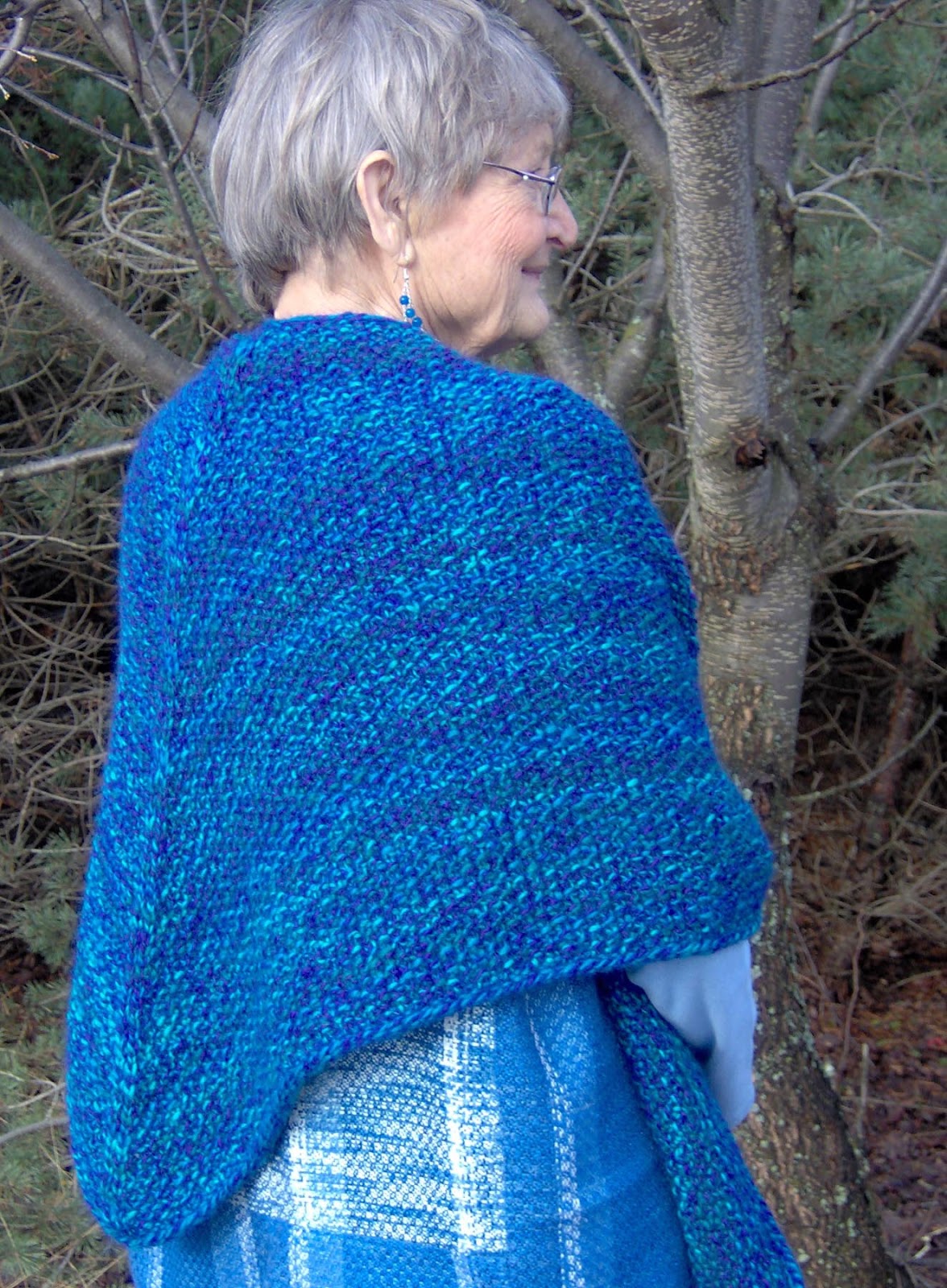
Modelling my "Atlantis" shawl, 2007:


Modelling her own lovely woven vest, 2007:


Another view of the vest, 2007:


Spinning some silk, 2007:


More spinning. Gladys in the foreground, Carol S. and Sally C. in the background, 2009:


Spinning, 2009:


Gladys in her beautiful hand spun, hand knitted sweater and hat (her design), 2010:


Gladys, I will think of you often.

Saturday, February 9, 2013

Winter Worthy Knits


It was a crisp -4degF when I took my dog out first thing this morning. But with the sun now above the horizon it’s a balmly +4degF. A perfect winter day for the 7th Annual Lake Ann Snow Pine Fest.

Lake Ann is a small village. This annual fest is charmingly village appropriate. Here are the activities listed on the flyer: “Lumberjack Breakfast, Chili Lunch, Snow Mountain, Quilt Show, Broomball, Animals of the World, Board Games, Sledding, Kids Crafts, Story Time, Antique Snowmiblie Display, Live Music, Hot Coco & Cookies, and So Much More!”

Life is good.

I’ve been especially happy with my dog walks not only today but all this winter because I had made myself a new scarf and new mittens. And both have held up quite well to daily use in November, December, January, and now February.

Here’s a picture of the scarf:


I knitted this scarf last summer. At the time, I wasn’t expecting to keep it for myself, but I was so totally charmed by the colors that I couldn’t give it up. I knitted it from some yarn that I’d spun a few years back. This was yarn left over from 2 other projects knitted from the same yarn: a pair of socks (which I still have), and a petite pocho (which I sold).

  
I’d made the yarn from two differently dyed combed top. I’d spun three 2-ply yarns: one yarn from one top, another yarn from the other top, and the third yarn was one ply from each top.

The body of the scarf is worked in stitch pattern #16 from Knitting Lace, by Susanna E. Lewis. For the edge, I actually crocheted! I used a variation of a crocheted “Simple Lace” edge from the book Interweave’s Compendium of Finishing Techniques by Naomi McEneely.

I’d started the mittens on my way home from the Wisconsin Sheep & Wool Festival last September.  It was awhile before I finished them because I kept ripping out to revise. Here’s a picture:


I’d spun the yarn from Lizzy’s fleece. Lizzy is half Ile de France and she produces super elastic wool. Then I dyed the yarn with the help of my friend, Carol S . I called the colorway, “Fruit Heaven”.

I used a delightful slip stitch pattern, “Nubbly Tweed” from the Harmony Guide, vol 3 (1998 reissue). The structure of the mitten was loosely based on the instructions in The Knitter’s Handy Book of Patterns, by Ann Budd.

Oh, wait. Here’s a better picture of the mittens…..


Tuesday, February 5, 2013

Creative Confluence


I am in the midst of a creative knitting storm. The January workshop for which I swatched so compulsively is spilling over into my preparations for a workshop I’m teaching in March.

The Michigan Fiber Arts Symposium  is a new event, sponsored by Michigan Fiber Festival, Inc. It will be held March 22-24, 2013 in Kalamazoo, Michigan.

I am scheduled to teach three days of workshops. On Friday, I’m teaching “Spinning & Knitting Energized Singles”; on Saturday, “Creating the Yarn You Want”; and on Sunday, “Blending Colors at the Wheel”. The latter two workshops I’ve taught numerous times. The first workshop on energized singles I haven’t taught for a number of years.

So, to get into the mood for that workshop, I thought I’d prepare some new knitted samples. As I knitted a few swatches, I got an idea for a vest. In my fiber stash I found just the right fiber: some lovely Wensleydale rovings dyed by Chris Roosien of Briar Rose Fibers. I gathered together colors in the blue, green, purple direction and started spinning. Then I started knitting.  Here’s a picture of the knitting in progress. What lovely colors! What intriguing texture!


As I’ve prepared other swatches for this workshop, I’ve played with a number of the stitch patterns that I’d explored in January. I’ve found that many knit-purl stitch patterns will do interesting things when worked with an “unbalanced” or energized singles yarn. Not all knit-purl patterns yield cool results, but some are really surprising.

Look at this swatch, for example:


Can you tell what the stitch pattern is? It’s “Pennant Pleating”! Such an interesting result is compelling me to knit more swatches with energized singles and to re-organize my workshop. I’m falling in love again with energized singles. I can hardly wait to share some of my new explorations in the March workshop!

Thursday, January 31, 2013

Mini Workshops in February


I’m not travelling to teach during the month of February, so I’m taking that time to offer some “mini” workshops for very modest (bargain-basement even!) fees.  Since I’ve been playing lately with some knitting ideas, most of these workshops are about knitting.  The first two, however, also include spinning.

If you are interested in attending, contact me by email, atyler@centurytel.net, or by phone, 231-640-4424.

All mini workshops are at my house in Lake Ann, Michigan.  Please note the day and time of workshops vary.  The fee for each is a stunningly low $10.  A minimum of 2 folks will be needed for each workshop to “go”.  The maximum is 6.  For those workshops that are presented in parts, the parts are fairly independent of each other, so you can take any one part or all parts.

Wednesday, February 6, 2013
      1:00 – 3:00pm
      Spinning & Knitting Energized Singles, Part 1:  Yarns that are not “balanced” can create biasing fabric when knitted.  In this mini workshop we will explore how twist in singles yarns influences stockinette stitch, reverse stockinette stitch, garter stitch, and seed stitch.  We will cover twist direction, twist magnitude, and knitting needle size.

      Bring your spinning wheel, 2 bobbins, some fiber to spin (or I can provide, $3 per ounce), and knitting needles in a few different sizes.

Wednesday, February 6, 2013 (yes, the same day as Part 1)
      3:00 – 5:00pm
      Spinning & Knitting Energized Singles, Part 2:  In part 2 of this workshop, we will explore how energized singles behave when you combine different stitch patterns.  Resulting knit fabrics will display a delightful variety of textures, some 2-dimensional, and some 3-dimensional.

      Bring your spinning wheel, 2 bobbins, some fiber to spin (or I can provide, $3 per ounce), and knitting needles in a few different sizes.

Thursday, February 7, 2013
      1:00 – 3:00pm
      Shaping With Stitch Patterns, Part 1:  Many knitted pieces, such as a sweater, require shaping.  Most often, that shaping is accomplished by increasing and decreasing the number of stitches you are using.  In this workshop, we will cover how to shape the structure of a knitted piece by selecting the right stitch patterns.  In part 1, we will cover how ribs, welts, and pleats pull in and pull up fabric.  In the process, we will discuss the importance of both stitch gauge and row gauge, and techniques of blocking your knitting.

      Bring 100-200 yards of yarn, knitting needles appropriate for the yarn.  I suggest sport to worsted weight wool yarn in a solid, light color.

Wednesday, February 13, 2013
      1:00 – 3:00pm (maybe a bit longer)
      Seams to Be:  In this workshop we will practice a variety of ways to seam knitted pieces together for the best results.  We will explore side and shoulder seams, invisible and decorative seams, and seams that are flat and tidy on both sides of the knitted fabric.  In the process, we will also cover strategies for creating knitted edges that make seaming easier and more refined.

      Bring 2 swatches using the same yarn, both 20 sts wide and 40 rows long in st st, leaving the last row live and placed on stitch holders.  100-200 additional yards of the yarn, knitting needles appropriate for the yarn, and a darning needle.  I suggest using a solid, light colored yarn so that the stitches are easier to see.

Thursday, February 14, 2013
      1:00 – 3:00pm
      Shaping With Stitch Patterns, Part 2:  In part 2 of this workshop, we will explore stitch patterns that not only influence stitch and row gauge, but also influence the elasticity of knitted fabrics.

      Bring 100-200 yards of yarn, knitting needles appropriate for the yarn, and a cable needle.  I suggest sport to worsted weight wool yarn in a solid, light color.

Wednesday, February 20, 2013
      2:30 – 4:30pm
      Shaping With Stitch Patterns, Part 3:  In part 3 of this workshop, we will explore stitch patterns that bias and stitch patterns that curl in a diagonal direction.  We will discuss why they behave this way, and how to use them as a design feature.

      Bring 100-200 yards of yarn, knitting needles appropriate for the yarn.  I suggest sport to worsted weight wool yarn in a solid, light color.

Wednesday, February 27, 2013
      2:30 – 4:30pm
      Surprising Knit Maneuvers:  In this workshop, we will swatch some stitch patterns that you’ve likely never seen before.  They involve lengthy-to-describe yet easy-to-perform maneuvers with your needles.  And they result in intriguing fabrics that will inspire!

      Bring 100-200 yards of yarn, knitting needles appropriate for the yarn.  I suggest sport to worsted weight wool yarn in a solid, light color.

Tuesday, January 29, 2013

The Puzzle of Bias


I have a vintage treasure:  an old knitting magazine that I got from some long ago rummage sale. The cover of the magazine is missing. There is no indication of publication date, but I suspect from the designs that it was published in the 1940’s. I nearly gave this magazine away in a fit of shelf cleaning, but then I noticed the section in the back containing a dozen or so stitch patterns. After a quick perusal I realized that this small collection contained several unusual stitch patterns that I’d never seen before.

In 2011, I used one of the patterns, “Cayce”, for the edges and collar of my Tattoo jacket. 

Last month, I swatched a number of other patterns from this collection.  One was “Cross Stitch Mesh”.

Cross Stitch Mesh
(multiples of 3 sts)

Row 1 (RS):  k2, * yo, k3, pass first k st over 2 k sts, rep from * end k1.
Row 2:  p
Row 3:  k1, * yo, k3, pass first k st over 2 k sts, rep from * end k2.
Row 4:  p

Here’s a picture of the swatch.


See how it biases upward and to the right? I’d experienced something similar several years ago in a shawl I’d designed with a very similar stitch pattern. I wanted to know why these patterns biased. So, I went on a theme-and-variation swatch-a-thon.

After several variations, I was convinced that it was the “pass stitch over” maneuver that caused the bias. To test this hypothesis, I knitted up a few other stitch patterns that included a “pass stitch over”.  Here are three:

Camulo (also from the vintage magazine)
(multiples of 9 sts plus 3)

Row 1 (RS):  p3, * yo, k3, sl the yo over the 3 sts, k3, p3, rep from * across row.
Rows 2, 4, 6, 8:  k3, *p6, k3, rep from * across row.
Row 3:  p3, * k1, yo, k3, slip the yo over the 3 sts, k2, p3, rep from * across row.
Row 5:  p3, * k2, yo, k3, slip the yo over the 3 sts, k1, p3, rep from * across row.
Row 7:  p3, * k3, yo, k3, slip the yo over the 3 sts, p3, rep from * across row.

Here’s a picture of the swatch:


A cool pattern I expect to use in the future.  But it did NOT bias.

I found two similar and interesting patterns in an old knitting booklet on my shelf (Nomis Knitting Primer, published in 1988 by the Nomis Yarn Co, Stoughton, MA)

Nomis Booklet, Pattern #12
(multiples of 2 sts)

Row 1 (RS):  k1, * yo, k2, pass the yo over the k2, rep from *, end k1.
Row 2:  p

Here’s the swatch, with no bias.


Nomis Booklet, Pattern # 90
(multiples of 2 sts)

Row 1 (RS):  k1, * sl1, k1, yo, pass sl st over the k1 and yo, rep from *, end k1.
Row 2:  p
Row 3:  k2, * sl1, k1, yo, pass sl st over the k1 and yo, rep from *, end k2.
Row 4:  p

And here’s this swatch. No bias here either.


So, I concluded the “pass stitch over” was not responsible for the biasing effect.  And it didn’t seem to be the number of stitches that were passed over.  So, I tried more variations of Cross Stitch Mesh to find out the real reason.

I noticed that in the patterns that did not bias, the yo was incorporated into the pass stitch over, while in the patterns that did bias, the yo was separate from the pass st over. I got to thinking that perhaps the biasing was just due to the distance between the increase (yo) and the decrease (pass stitch over).

After swatching several more variations, it was clear to me that the separation of the yo and the pass stitch over was indeed responsible for the bias. Think of it this way: if you want to create a biasing fabric, you put an increase on one edge and a decrease on the other. That’s what’s happening with the CSM pattern.

Here’s some of the “evidence”. For CSM Variation #9, I reversed the order of the yo and the pass stitch over, expecting to see the fabric bias in the opposite direction.

Cross Stitch Mesh, Variation #9
(multiples of 3 plus 2)

Row 1 (RS):  k1, * sl1, k2, pass the sl st over the k2, yo, rep from *, end k1.
Row 2:  p

Yup! It biased upward and to the left.


More evidence:

Cross Stitch Mesh, Variation #10:  it seemed that it was really only the far right increase and the far left decrease that caused the bias, so I tried a swatch that was mostly st st, but with one patt repeat.
(any number of sts more than 5)

Row 1 (RS):  k1, yo, k to 4 sts from end, sl1, k2, pass sl st over the k2, k1.
Row 2:  p

This swatch, with only one repeat of the stitch pattern, still biases upward and to the right.


For the last in the series of swatches, I wanted to verify that the specific stitch decrease you use doesn’t change the biasing. I used a SSK instead of the pass stitch over.

Cross Stitch Mesh Variation #12.
(multiples of 3 sts plus 2)

Row 1 (RS):  k1, * yo, k1, ssk, rep from *, end k1.
Row 2:  p

The swatch still biased.


I had (and still have) the urge to swatch more variations, but I stopped at 12 variations. I did play with needle size on some other swatches of CSM, only to find that needle size had essentially no effect on the magnitude (angle of slant) of the bias.

This was a compelling series for me. And I do plan to re-knit the biasing shawl that I’d made several years ago. I have been “encouraged” to have that pattern ready by May. I’ll do my best.

One other thing: when you see pictures of these biasing patterns in stitch pattern collections, they do not show you that the stitch biases! It was an interesting lesson for me to learn.

Saturday, January 26, 2013

Welts Wave Too!


I’ve been asked to design an afghan/blanket for Chris Roosien of Briar Rose Fibers . I love working with her yarns; her color work is lovely and quite distinctively her own. I had a couple ideas that played upon some of my recent swatching adventures.

I was leaning toward a rib and welt sampler, something with just knit and purl stitches. So, yesterday I grabbed a few stitch pattern books off the shelf. This time, but for no particular reason, I chose the Harmony Guide books (the older publications).

Most stitch pattern books have a section at the beginning of the book on knit and purl patterns. This is where I focused my attention.

With my mind on ribs and welts lately, I was especially looking for stitch patterns that incorporated one or the other or both. I found a good handful of patterns with potential for the blanket.

But what smacked me across the face was a pattern called “Purl Triangles” in the first Harmony Guide. It’s an ordinary-looking pattern of triangles I’m sure my eyes had previously passed over innumerable times. This time I was looking at it in the context of my recent examination of pleating patterns. With a brain flash, I recognized this pattern as a horizontal version of Pennant Pleating.

Welt pleats! What a concept! The pattern as written wasn’t really taking advantage of the pleating effect, so I modified it and this morning I knitted up a small swatch to make sure it actually waved. It did.

To get horizontal pleats, it’s important to remember purl stitches come to the fore in welts, so you need to have a wave of purls that crash over knit stitches. In this pattern the wave crashes downward. You could reverse the order of rows to get the wave to crash upward.

Amy’s Welt Waves (or maybe Dr. Tyler’s Welt Waves)
(multiples of 12 sts plus 1)

Row 1:  *p6, k1, p5; rep from *, end p1.
Row 2:  k1, *k4, p3, k5; rep from *.
Row 3:  *p4, k5, p3; rep from *, end p1.
Row 4:  k1, *k2, p7, k3; rep from *.
Row 5:  *p2, k9, p1; rep from *, end p1.
Row 6:  k1, *p11, k1; rep from *.
Row 7:  k
Row 8:  p
Row 9:  p
Row 10:  k

Here’s the chart (patt repeat between thick vertical lines):


Of course, I want to spend the rest of the day knitting variations on this horizontal pleating.  I’ll do that eventually; just not today.