Tuesday, January 22, 2013

Rib Cousins Break Like Waves


As part of my preparation for my recent workshop, Shaping With Stitch Patterns, I did a bit of examination of pleating patterns: stitch patterns that create vertical folds.

They’re rather like cousins to rib patterns. Pleats share the elastic nature of ribs. Indeed, many of these patterns are just uneven ribs. In rib patterns, the knit stitches come to the fore and the purl stitches recede. To get the pleat – or fold – effect, it’s necessary that there be a gradation of knit and purl stitches so that the knit stitches build up and act like a wave breaking over the purl stitches.

I shared the Knife Pleating pattern earlier. Pennant Pleating is another wonderful example.

Pennant Pleating
(multiples of 10 sts)

Row 1 (RS):  * k2, p2, k6, rep from *.
Row 2:  * p5, k3, p2, rep from *.
Row 3:  *k2, p4, k4, rep from *.
Row 4:  *p3, k5, p2, rep from *.
Row 5:  *k2, p6, k2, rep from *.
Row 6:  *p1, k7, p2, rep from *.
Row 7:  *k2, p8, rep from *.
Row 8:  *p1, k7, p2, rep from *.
Row 9:  *k2, p6, k2, rep from *.
Row 10:  *p3, k5, p2, rep from *.
Row 11:  *k2, p4, k4, rep from *.
Row 12:  *p5, k3, p2, rep from *.

The gradation of knits and purls is easy to see when the pattern is charted:


The result here is a “wave” of knits that builds up and folds to the left over purl stitches.


If you want the wave to break to the right, simply reverse the order (L to R) of the knit and purl stitches.

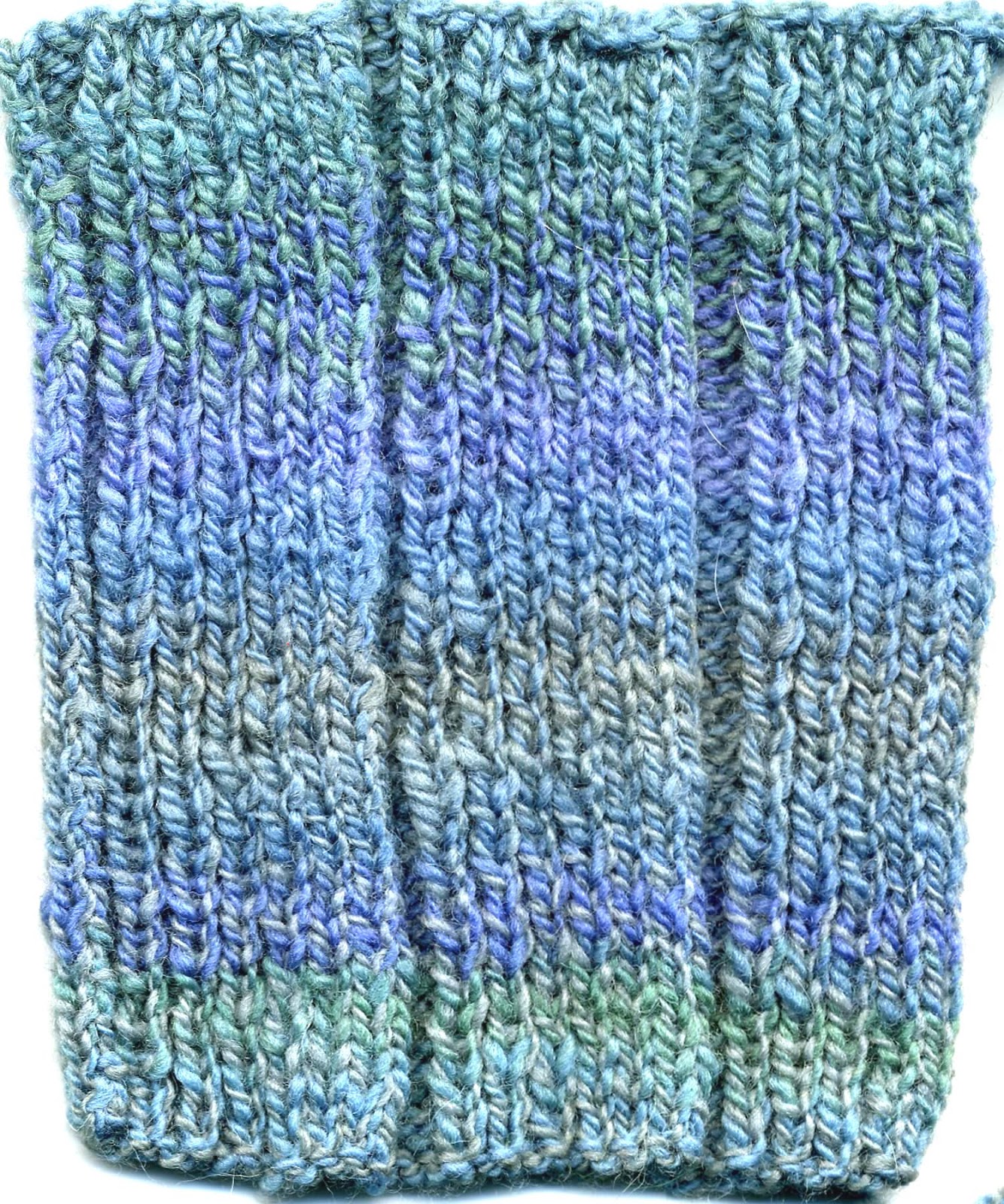
When you see these patterns in stitch collections, the pictured example is usually strongly blocked so that you do not see the pleating effect.  To get the pleats, you need to let the fabric relax. And, to get the best pleats, you need to be judicious in your choice of yarn. The curliness of the pleating is dramatically influenced by the yarn you use. Wool yarns are more likely to highlight the pleating effect, especially if you use very elastic wools (e.g., Cormo, Targhee, Babydoll Southdown).  Yarns that are from non-elastic fibers will show the stitch pattern more than the pleating pattern.  I knitted several swatches of Pennant Pleating, using different yarns.  The most pleat-like was from a handspun yarn from Ile de France wool (the swatch above).  There were several swatches that showed no pleating at all:  brushed mohair, cotton, bamboo, silk (swatch below), some wool blends. So, if the pleats are an important design element, then you need to also consider the yarn you use.


Although I did not do a systematic analysis, I suspect that needle size also influences the magnitude of the pleating. My hypothesis is that smaller needles (tighter gauge) will produce more dramatic pleats, and larger needles will show off the stitch pattern more than the pleats. Yippee! Another reason to knit more swatches!

Friday, January 18, 2013

Welts: Up-and-Down Elasticity


 Welts are the horizontal analogue of the vertical rib stitches: welts are delightfully elastic in the up-and-down direction.

Welts are created by putting knit stitches and purl stitches in horizontal arrangement. A 1X1 welt is none other that the humble-yet-amazing garter stitch.

Welts cause fabrics that pull in top-to-bottom; they shorten. And they shorten more as the width of the welt is increased. The swatches below (all 40 sts wide, 42 rows long) are, from top down: 1X1 welt (aka garter stitch), 2X2 welt, 3X3 welt and 4X4 welt.


Notice that in welts, the purl stitches come to the fore (convex) and the knit stitches recede (concave).

As with ribs, you can get similar elastic effects with uneven or broken welts.  I showed one of my favorite broken welts the other day, the Escalator Pattern.  Here are the instructions:

Escalator Pattern
(multiples of 32)

Row 1 (RS):  * k5, p11, rep from *.
Row 2:  * k11, p5, rep from *.
Row 3:  * k5, p11, rep from *.
Row 4:  p
Row 5:  k
Row 6:  p
Row 7:  p4, *k5, p11, rep from *, end k5, p7.
Row 8:  k7, * p5, k11, rep from *, end p5, k4.
Row 9:  p4, *k5, p11, rep from *, end k5, p7.
Row 10:  p
Row 11:  k
Row 12:  p
Row 13:  p8, *k5, p11, rep from *, end k5.
Row 14:  k3, * p5, k11, rep from *, end p5, k8.
Row 15:  p8, *k5, p11, rep from *, end k5.
Row 16:  p
Row 17:  k
Row 18:  p
Row 19:  k1, p11, * k5, p11, rep from *, end k4.
Row 20:  p4, *k11, p5, rep from *, end k11, p1.
Row 21:  k1, p11, * k5, p11, rep from *, end k4.
Row 22:  p
Row 23:  k
Row 24:  p

And here’s an uneven welt pattern that is actually a game: Wager Welt. I found it in one of my favorite knitting books, Mary Thomas’s Book of Knitting Patterns.

“…the game being to wager that no one will guess the number of rows to be purled in the receipt.” (Mary Thomas)


This is an 8-row repeat. How many rows are purled? The answer: one.

Wager Welt
(any number of sts)

Row 1 (RS):  k
Row 2:  p
Row 3-8:  k

(If you don’t already have Mary Thomas’s book, go out and get it. Now.)

Now, I like elastic fabrics. I like the elasticity of ribs. I like the elasticity of welts. And I especially like the elasticity of fabrics in which ribs and welts are combined.  Take the Double Basket Pattern for example.


Double Basket Pattern
(multiples of 18 sts plus 10)

Rows 1 & 5 (RS):  * k11, p2, k2, p2, k1, rep from *, end k10.
Rows 2 & 6:  p1, k8, p1, * p1, k2, p2, k2, p2, k8, p1, rep from *.
Rows 3 & 7:  * k1, p8, k2, p2, k2, p2, k1, rep from *, end k1, p8, k1.
Rows 4 & 8:  p10, * p1, k2, p2, k2, p11, rep from *.
Row 9:  k
Rows 10 & 14:  p2, k2, p2, k2, p2, * p10, k2, p2, k2, p2, rep from *.
Rows 11 & 15:  * k2, p2, k2, p2, k2, p8, rep from *, end k2, p2, k2, p2, k2.
Rows 12 & 16:  p2, k2, p2, k2, p2, * k8, p2, k2, p2, k2, p2, rep from *.
Rows 13 & 17:  * k2, p2, k2, p2, k10, rep from *, end k2, p2, k2, p2, k2.
Row 18:  p

This stitch pattern is perfect for a blanket. And it is one of those patterns best left unblocked; let the ribs and welts do their thing.

Wednesday, January 16, 2013

Ribs: Side-to-Side Elasticity


I got home Monday afternoon from The Soo. It was a delightful trip. The sponsoring guild, Country Spinners& Bridge Shuttlers , did a great job, and the teaching space at Gloria Larke’s store, Gloria’sHappy Hooker, was just fantastic.

I taught the knitting workshop, Shaping With Stitch Patterns, on Sunday. I was so excited to share some of my recent knitting thoughts.  As I prepared for the workshop, knitting all those swatches and deciding what to say, I came to realize that swatches are not only good for checking your stitches-per-inch and your rows-per-inch gauges. Swatches also give you important information about the drape of the knitted fabric and the elasticity of the knitted fabric.

Elasticity of knit stitch patterns became a major theme of the workshop.

We started out the workshop by examining stockinette stitch. Then we examined the effects of ribbing and welting (both quite elastic). Here are a few thought on the nature of rib stitch patterns.

Rib patterns are created by putting knit stitches and purl stitches in vertical arrangements. Compared to stockinette stitch, rib stitch patterns cause the fabric to pull in sideways.

The amount of pulling in increases as the rib width increases. The swatches below are all 40 stitches wide and 42 rows long. In order from the top, the swatches are: 1X1 rib, 2X2 rib, 3X3 rib, and 4X4 rib. I hope you can see that the 4X4 rib looks narrower than the 1X1 rib. In other words, the stitches-per-inch gauge increases as the rib width increases (when the swatch is measured not under tension).


Although these patterns pull the fabric in sideways, they all have a great deal of lateral elasticity: it’s easy to stretch the fabric out sideways. This phenomenon can be used to great advantage in sweater design: you can put these stitches in places that you want to be narrow looking while still having expanding ability.

You may also notice that when knits and purls are organized in vertical lines, the knits come to the fore (convex), and the purl stitches recede (concave).

The rib stitch patterns above all have knit and purl columns of equal width. The elastic effects of these stitches also occur in patterns where the rib columns are of unequal width or when the rib pattern is “broken”. Here are two wonderful expamples:

Knife Pleating (multiples of 13 sts)

Row 1 (RS):  * k4, p1, k1, p1, k1, p1, k1, p3, rep from *.
Row 2:  *k3, p1, k1, p1, k1, p1, k1, p4, rep from *.


Deep Chevron Pattern (multiples of 18 sts)

Rows 1 & 3 (RS):  * k1, (p2, k2) twice, p1, (k2, p2) twice, rep from *.
Rows 2 & 4:  * (k2, p2) twice, k1, (p2, k2) twice, p1, rep from *.
Rows 5 & 7:  * (p2, k2) twice, p3, k2, p2, k2, p1, rep from *.
Rows 6 & 8:  * k1, p2, k2, p2, k3, (2p, k2) twice, rep from *.
Rows 9 & 11:  * p1, (k2, p2) twice, p1, (k2, P2) twice, k1, rep from *.
Rows 10 & 12:  * (p2, k2) twice, p1, (k2, p2) twice, k1, rep from *.
Rows 13 & 15:  * (k2, p2) twice, k3, p2, k2, p2, k1, rep from *.
Rows 14 & 16:  * p1, k2, p2, k2, p3, (k2, p2) twice, rep from *.


Next time, I’ll point out some interesting effects of welts. Oh boy!

Tuesday, January 8, 2013

53


I am driving to “The Soo” (Sault Ste Marie), Michigan on Friday for 2 days of teaching.  This makes me happy!  I’m teaching “Spinning With Commercial Yarns” on Saturday, and “Shaping With Stitch Patterns” on Sunday.

The latter of those two workshops is a new one for me.  To prepare, I started knitting swatches in November.  And I couldn’t stop.  Well, I could stop, and I did stop, but only after I’d knitted 53 swatches.  Here’s what that looks like (yes, I'm still using the crappy camera, not the new one):


In the process of knitting all those swatches, I immersed myself in the nature of knitted fabrics.  I played with several stitch patterns that I’d previously not tried, and I systematically explored stitch patterns that I’d used but not really understood.  It was a fantastic journey into knitting.

I prepared 15 pages of notes for workshop participants.  That’s a lot.  I included a number of stitch patterns and pictures of some of my swatches.  For those pictures, I used my flat bed scanner.  It works reasonably well, although I typically needed to lighten the jpgs so they would show up reasonably well in b/w print.  Here is a picture of what is called “Escalator Pattern” in Mary Thomas’s Book of Knitting Patterns.  It’s a charming broken welt pattern that is very easy to knit, yet creates an attention-getting effect.


In future blogs, I plan to share some of the “ah-ha!” moments that came to me in the knitting of 53.  Stay tuned.

Friday, January 4, 2013

What a Difference a Day Makes


I’d like to report that it’s sunny today.  But it’s not.  (I did see a tiny patch of blue at one point.)

However!  Just a few hours after I posted yesterday’s blog entry, I received a package in the mail.  It was from my brother, John.  And it was . . . A CAMERA!

He sent me one of his older digital SLR cameras.  I’ve wanted one ever since I stopped using my faithful old Pentax Spotmatic (manual SLR) a few years ago.  John had a spare sitting around, and so he sent it to me.  Thank you, John!!!!

This camera is a Pentax too.  An “ist DS”.  He also sent along a 18-55mm zoom lens, a couple of memory cards, and some batteries.

There are a few glitches that I need to work out:  I had to download an owners operating manual for the camera.  And I can’t seem to get the software for photo downloading to work.  Never the less, I am very excited about this new-to-me camera.  I hope it doesn’t take too terribly long to learn how to use it.

I can’t believe I get control over depth of field again!

Here’s a related, small-town story:  My brother sent the camera USPS, insured and needing receipt confirmation.  I signed all the little cards to prove that the package had arrived at its intended destination.  A few hours later, the Lake Ann postmistress, Amy Carmien, called me.  She is a friend of my roommate, Joanna.  Joanna had recently given Amy C my cell phone number when Amy lost power due to a winter storm.  Joanna had offered to let Amy come over to use the shower.

Anyway . . . it turned out that John had forgotten to put his mailing address on the delivery confirmation card.  Amy had called me to see if I could provide a return address for whomever had sent me the package.  How many of you would get such a personal call from your local post office?

Thursday, January 3, 2013

How to Start the New Year Out Wrong


I had every intention of writing bog entries frequently in December, and even more frequently in 2013.  But I’ve let a few minor issues stymie me.

Mostly, I’m having trouble taking good pictures of the things I want to write about.  I have a crappy camera that really only takes good pictures with lots of natural light.  And at this time of year, the sky is grey grey grey.  And the house where I currently live is an old house, built around 1900.  It’s a charming house, but it gets very little light.

So, I’ve been waiting for the sun to come out.  That could be awhile…..

(In addition to the lighting issue, I’ve been spending rather a lot of my time lately cooking and baking.  Delicious, but not part of my fiber work.)

Excuses, excuses.  My friend, Sylvia VM, finally called me up yesterday and told me she was sick of seeing that picture of the broken bowl on my blog.  And she called me this morning too to further chastise me for not blogging.

So I swore to her that I would write today.  And I took pictures.  They are not good, but they’re the best I can do for now.  Here goes.

A few days ago, I got the urge to finish a project that had been lingering on my rigid heddle loom for months.  I had started making “mug rugs”.  I put a 4-inch wide warp (linen thread) on my loom at 10 dents per inch.  Since this was my first try at weft-faced fabric, I used a rather short warp, only enough length for 2 or 3 mug rugs.  I used a wool-linen blend yarn for the weft.

I got inspired to try this technique by Jane Patrick’s book, The Weavers Idea Book.  I can always use more mug rugs.

I’d finished the first 2 mug rugs a few months ago.  How nice, I thought, to finish this project as the old year ends and a new year begins!  How nice, indeed….

While weaving the 3rd and final mug rug, as I beat the weft into place, there was a sharp snap and the warp went flying.  The rear warp stick – to which the warp threads were tied – cracked in half!  I broke my loom!  Not an auspicious beginning to the new year.

Here’s the break:


And here are the 2 mug rugs I actually finished.  I like them, but at what cost?


I will try to glue the piece together.  If that doesn’t work, I’ll try to get a replacement piece.  And, I will likely never try to weave weft-faced fabric on this loom again.

Wednesday, December 12, 2012

Broken Bowl, Broken Heart


On Monday night I was watching TV and knitting swatches for a workshop I’m teaching in January .  My sweet-and-arthritic dog, Toby, jumped up onto the sofa to join me, and in the process she knocked my knitting bowl off the sofa and onto the wood floor.  The bowl broke.

This is not just any bowl.  At least to me.  It was the very first thing I ever bought at an art fair, in the 1970’s while I was a modern dance student in Salt Lake City.  I was a very poor college student, so parting with money for something other than food or clothing or books or dancewear was not easy.

But, I was smitten by the bowl from the first.  I like to be slightly mystified by art, and the glaze on the bowl mystified me.  Were they butterflies?  Angels?  Folded up coats?  Were they connected with a ribbon?  Or a river?  Or the wind?  I loved the colors:  muted, mostly grey, with blues and greens.  Dreamy.

It was a shallow bowl, about 10 inches in diameter and only 4 or 5 inches deep.  Since I bought that bowl, I have moved more than twenty times.  And that bowl has always gone with me.

For many years, I simply admired the bowl.  I hardly ever put anything in it, until I started knitting.  Then I found this bowl to be a perfect knitting accessory.  My yarn would tumble nicely in the bowl, undoing any inadvertent twist I may have added to the yarn while knitting.  And:  I could look at and admire the beauty of the bowl.

Now, I’ve showed this bowl to many people over the years.  And no one has thought it as delightful as I.  This used to disappoint me, but then I came to treasure the bowl even more because I was the only one who thought it was exceptionally beautiful.  My feelings about this bowl were definitely more about me than about the bowl.  And I came to value that.

So, when I watched the bowl fall in slow motion toward the floor, I didn’t think it would break.  After all, the bowl has been with me and remained unscathed for over 30 years.  When it broke, I was stupefied.  I was so shocked that I couldn’t move.  My roommate took pity and swept up the debris.  She suggested I try gluing it back together.

I went to bed, supremely depressed and not a little bit ashamed of myself for having such strong feelings for a thing.  It’s just a bowl.

I did buy super glue yesterday.  Perhaps later today I’ll put the pieces back together.